What happened with nginx?
On November 18, 2026, nginx released versions 1.30.7 and 1.31.9, which fix five flaws that the security company Xint, which discovered them, has named NGINX2Root. F5, the company that develops nginx, rates them at 9.2 out of 10 for severity. The most widespread one has been in the code since 2015 and, according to Xint, lets someone without a password run commands on the server of a website that uses HTTP/2, a modern and very common way of delivering pages. And it's being talked about so much because nginx is behind almost one in three websites whose server is known, 31.3% according to W3Techs.
What is nginx and why does it matter?
nginx is the program that, on the server, receives each visit and delivers the page you ask for. It's used by online shops, blogs, websites of small businesses and large companies. You don't see it when you visit them.
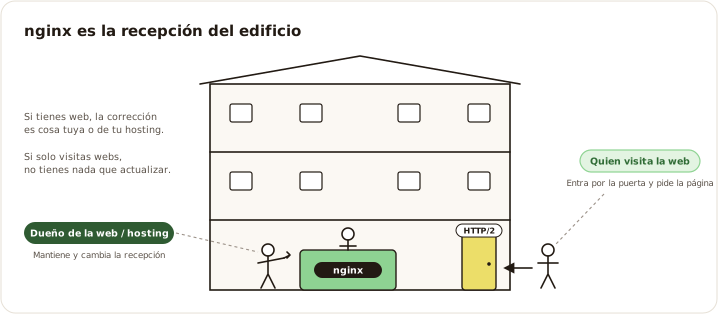
Think of it as the front desk of a building. The website is the building, and the front desk is the one that attends to each person who comes in and gives them what they ask for. HTTP/2 would be the fast door, the one almost everyone uses today. The flaw is in that front desk, and the one who has to replace it is the building's owner. You, when you visit that website, are the one who walks in to ask: you can't replace the front desk, and it isn't your job to.
That's why this flaw is a matter for whoever owns the website, not for whoever visits it. Even though nginx is in the news a lot these days, neither your computer nor your phone has anything to update because of this particular flaw. What is worth knowing is what you might notice as a visitor and what to do if it happens, which is what comes next.
Should I stop visiting websites?
No. You can keep browsing as usual. The risk lies with the servers that don't install the fix: on those, an outsider could end up taking control, and that can be noticeable from the visitor's side.
How would you notice? A website that suddenly behaves oddly, shows you a strange warning or sends you to another page, or a download you didn't ask for. None of this is new or unique to this flaw, and it's avoided with the same precautions as any other day. Don't install anything you didn't ask for yourself. Be wary of warnings that rush you, like those saying your device has a fault and you must update something right now. And keep your browser up to date. If a website you know behaves strangely, close it and come back later.
What about my data on the websites I use?
It depends on each website, and it's each website that has to tell you if something has gone wrong. As of today, there is no public information confirming that anyone has exploited these flaws: as of November 18, none of them appeared in the catalog of exploited flaws kept by the US cybersecurity agency (CISA), according to Cloudflare Radar, and Xint did not publish the final steps of its attack.
If a website you use is under maintenance or running a little slower these days, the most likely reason is that it's being updated or that HTTP/2 has been turned off as a precaution, a temporary measure that doesn't stop it from working.
If a website where you have an account warns you about a security incident, follow its instructions and, if it asks you to change your password, do so by going to its official page yourself, not through a link you receive by email.
What if I have a website, even a small one?
Then yes, you do need to check, but you don't need to know anything about servers: nginx is updated by your hosting company or whoever manages your server, and all you have to do is ask. In our guide nginx vulnerability 2026: how to tell if it affects your website and what to ask your hosting provider we show you what to look at and give you a ready-to-copy email for your hosting provider. And if you'd rather start with the quick option, the free NGINX2Root checker tells you which nginx version your website declares and whether it offers HTTP/2, and the Wakaris analysis explains it in plain language along with the rest of your website.
Have a website? Analyze it for free. We explain it clearly.
Frequently asked questions
Was it found by artificial intelligence?
Partly. According to Xint, one of its researchers found the first flaw, and a few days later an automated analysis by its platform found the other four without human guidance; F5 also credits other researchers for two of them. The flaws were in nginx's code. Xint frames it as part of AI-assisted research, which is finding flaws faster than ever.
Is it already fixed?
The fix has been available since November 18, 2026, in nginx versions 1.30.7 and 1.31.9, and Debian and Ubuntu have already published their patched packages. But it doesn't install itself: each server has to be updated and nginx restarted, and that can take days or weeks.
How long will it last?
It will most likely be talked about for weeks, because many servers are slow to update. And nginx isn't an isolated case: according to Xint, nginx's list of security advisories recorded two new flaws in all of 2025 and 26 up to November 17, 2026, not counting these five.
Sources cited
- nginx.orgnginx security advisories, nginx.org: the five flaws and the patched versions.
- xint.ioNGINX2Root, Xint: how they were found, what they allow and how nginx's advisories have evolved.
- radar.cloudflare.comZero Wire: nginx2root, Cloudflare Radar: severity according to F5 and exploitation status.
- w3techs.comUsage of web servers, W3Techs: nginx usage.
- ubuntu.comCVE-2026-123007, Ubuntu: patched packages.
- security-tracker.debian.orgCVE-2026-123007, Debian: patched packages.
Authors of this report



Updated: November 20, 2026.