In short
What’s checked
five pieces of data declared in the code: authorship, publication and modification dates, FAQs, and Q&A content.
Where they’re declared
in structured data, using the Schema.org vocabulary.
Why it matters
Google says the more recommended properties you provide, the higher the quality of the result.
Severity in Wakaris
Important. It’s triggered on 5.0% of the pages where this check runs, according to the Wakaris catalog.
What this finding is and what it measures
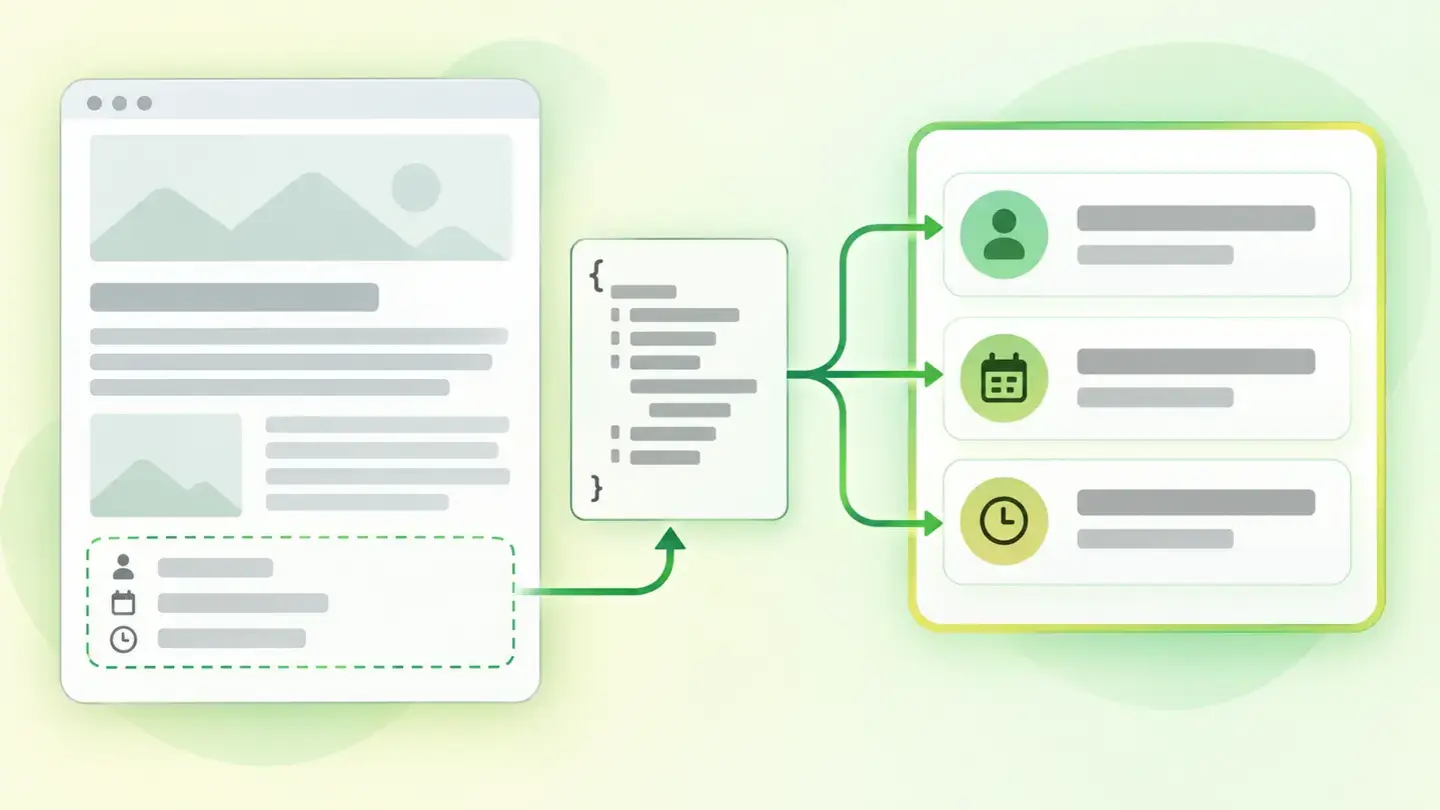
Someone who opens your article sees the byline in the header and the date under the title, and that tells them where they stand. A system reading the page infers nothing from the layout: it needs that data declared separately, in a structured data block written with the Schema.org vocabulary, where author is the author of the content, datePublished the date of first publication and dateModified the date of the most recent modification.
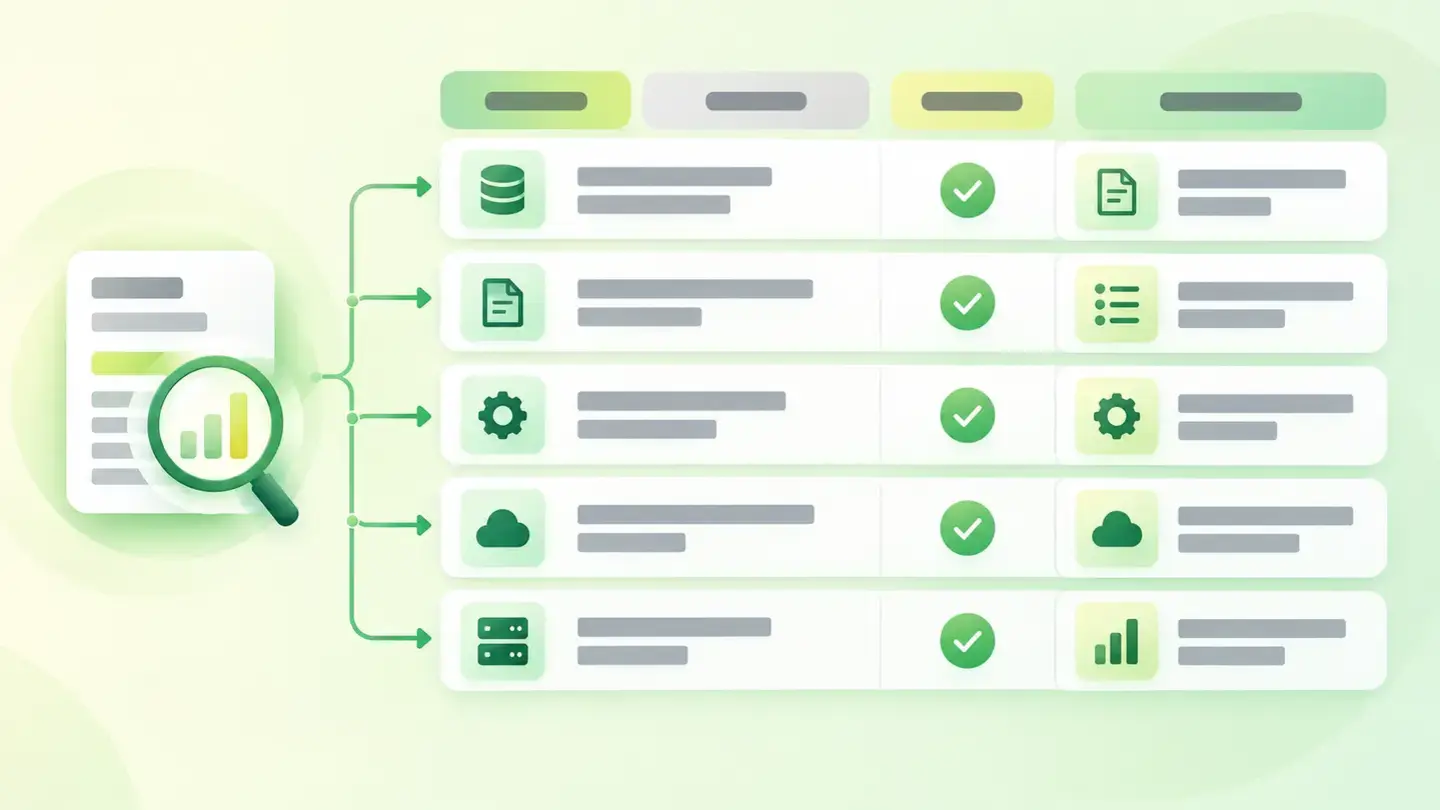
The finding groups five checks. Three are about identity and time: declared authorship, declared publication date and the consistency of the modification date. The other two are about the form of the content: whether there are FAQs marked up as such, and whether Q&A content is declared. Four check that the data exists; the modification date check is the only one that also checks that it adds up.
How it’s checked
Wakaris reads the structured data of the URL you give it and tells you which of the five is missing, with nothing to install. Seeing them separately matters because each has a different fix: a byline is a field, and date consistency is a template review.
Three limits this article states. First: the Wakaris catalog doesn’t say what the modification date has to match (the date visible on the page, the publication date, or both), so the article doesn’t commit to any criterion. Second: it also doesn’t say whether FAQs and Q&A content are alternatives or both are required, and that decides whether the finding is correct, because they’re different types for different content. And third: this check has run 539 times compared with more than four thousand five hundred for most checks, so the 5.0% refers to the pages where it ran, not to all websites; the condition that triggers it isn’t recorded.
Why it matters
The solid, sourced argument is about understanding. Google sets as a general rule that structured data must be a faithful representation of the page’s content, that content not visible to the reader shouldn’t be marked up, and that the more recommended properties you provide, the higher the quality of the result. For articles, it explicitly recommends author, author.name, datePublished, dateModified, headline and image.
There’s an honest caveat worth putting up front. The FAQ rich result in Google Search stopped appearing on May 7, 2026, and its documentation was removed in June of that year. In other words: marking up your FAQs no longer gets you that enhancement in results. The markup is still valid and still declares which question each block answers, and this finding sits in the AI visibility area, not SEO; but there’s no primary source to cite on what different AI systems do with this data, so no claim is made here.
Common causes
The first is having no structured data at all. Many templates don’t generate it, and whoever writes the content has no reason to know there’s a layer of code running parallel to what’s visible.
The second is the byline left out. The text has the author’s name in the header, but the declared block doesn’t include it, or includes it wrongly: Google asks that author.name specify only the name, without job titles or honorifics, and that with several authors each one goes in its own field, without merging them.
The third, and the most frequent on sites that already have structured data, is a neglected modification date. It’s generated on publication and never touched again, or the content management system updates it every time someone saves a comma, so it stops meaning anything. And the fourth is format: both dates go in ISO 8601 format, and Google recommends including time zone information, because if you don’t, it applies its own crawler’s.
How to fix it
Wakaris tells you which of the five pieces of data is missing, and that’s the order of work. The first three are template-level and are fixed once for the whole site.
Start with authorship and dates, which is what’s almost always missing: declare author with just the name, and datePublished and dateModified in ISO 8601 format with a time zone. Make sure the declared date is the same one shown on the page, because Google’s rule is that markup mustn’t describe anything that isn’t visible and must be a faithful representation of the content.
Then decide what your content is before marking it up. FAQs are the questions your organization expects people to ask; Q&A content is what users write in a forum or similar. They’re different types and not interchangeable: choosing the wrong one breaks the faithfulness rule. And don’t mark up questions that don’t exist on the page just to pass the check: that’s exactly what Google prohibits.
Table with the five pieces of data the finding checks and what each one declares
Brief to generate the image
Editorial illustration for a Wakaris technical guide.
Topic: Table with the five pieces of data the finding checks and what each one declares.
Style: white background with a soft lime→pale green wash (#F8F7D6 → #E2F2DC), green→lime gradient accent (#8ED390 → #DCD86F), near-black ink (#12150B), pill shapes and rounded corners, soft shadows, clean schematic look, no photography.
Format: 16:9, 1440 pixels wide.
No legible text: any label, code or figure is shown as gray placeholder bars. The caption carries the meaning, not the image.
No real logos or third-party brands. No recognizable people.
Tags: structuring, citability, table, data, checks, finding, declares
Ask your AI
If you want to dig into your specific case, copy one of these two prompts and paste it into the AI you use. Pick the one that fits your situation.
I already have the finding measured with Wakaris and want to fix it
Act as a professional, careful web technical auditor. Your goal is to help me understand a specific finding about my website and decide what to do about it, without making anything up.

Context: I got this finding with Wakaris, a tool that analyzes a website across 9 areas (performance, SEO, security, social, market, AI, experience, accessibility and legal) and explains each problem so that every role on a team can understand it. The finding is: Structuring for citability. It checks five pieces of data declared in my page’s code: authorship, publication date, consistency of the modification date, FAQs marked up as such, and Q&A content. Reference: they’re declared in structured data using the Schema.org vocabulary, and the cut-off is the data being absent.

Paste the Wakaris result here: which of the five pieces of data you’re missing and on which page. If you don’t have it, tell me and I’ll explain how to get it before we continue.

Rules you must follow at all times:

1. Don’t assume anything about my website. Every piece of data you use must come from what I confirm or from what Wakaris has measured. If you don’t know it, ask me before stating it.
2. Before giving me conclusions, ALWAYS ask me these questions, together and in plain language, to find out whether this finding really affects me and where:
   a) What type of page was analyzed: an article or blog post, a product page, a services page, a forum?
   b) What platform is your website on? (WordPress, Shopify, custom-built site, other)
   c) Are articles signed with a visible name, or does the brand publish them without an author?
   d) Is a date shown on the page? Do you know whether it updates when you edit the content, or stays as the day it was published?
   e) Do you have an FAQ section written by you, or Q&A content written by users?
   f) Can you edit the site template, or only the content of the pages?
   g) If the template needs changing, would you do it yourself, an in-house technician or an agency?
3. Every statement or recommendation must be argued in relation to MY context, not in general. If you recommend something, explain why it applies to my case.
4. Always state your level of certainty. If something is a hypothesis because you can’t measure it, say so: you can’t see my website, you’re reasoning from what I tell you.
5. Don’t suggest declaring anything in the code that isn’t visible on the page, marking up questions that don’t exist, or using a date that isn’t the real one: the rule is that what’s declared must be a faithful representation of the content.
6. If you need data that can only be obtained by analyzing the website (confirming what’s declared today, or whether the fix worked), tell me and recommend that I run the page through Wakaris again: that gets checked, not guessed.
7. The final decision is mine, not yours. If the fix is beyond what I can do myself, help me get the problem ready to hand over: what it is, where it is, why it matters and what needs to be done, in an actionable format for that person.

Source for this finding: https://www.wakaris.com/en/guides/ai-visibility/structuring-for-citability
To check it or check it again: https://www.wakaris.com/

Start by briefly introducing yourself in your role and asking me the first block of questions.
I haven’t measured it yet and want to check whether my website has this problem
Act as a professional, careful web technical auditor. I’m investigating whether my website has a specific problem and I want you to help me find out honestly, without taking it for granted.

Context: I got here through Wakaris, a tool that analyzes a website across 9 areas (performance, SEO, security, social, market, AI, experience, accessibility and legal) and explains each problem so that every role on a team can understand it. The problem I want to investigate is: Structuring for citability. It means my content doesn’t declare in its code who signs it, when it was published, when it was updated and what questions it answers. Reference: that data is declared in structured data using the Schema.org vocabulary. I DON’T know yet whether my website has it: I want to find out.

Rules you must follow at all times:

1. First and most important: this is checked by reading my page’s code, and you can’t analyze my website from this conversation. Make it clear from the start that you won’t be able to give me a definitive "yes, you have it" or "no, you don’t," only a hypothesis based on what I tell you.
2. Don’t assume anything. Before giving me any assessment, ALWAYS ask me these questions, together and in plain language, to estimate whether I’m likely to have it:
   a) Do you publish articles, blog posts or guides, or is your website just fixed pages?
   b) Is your content signed with a visible person’s name?
   c) Is a date shown on your content? Does it update when you edit it?
   d) What platform is your website on? (WordPress, Shopify, custom-built site, other; or I don’t know)
   e) Has anyone set up structured data on your website, or are you not aware of it?
3. With my answers, give me a clear estimate of whether it’s LIKELY or UNLIKELY that I have it, and which of the five pieces of data would be the suspect, argued from what I’ve told you and explicitly marked as a hypothesis, not a diagnosis.
4. Tell me directly that the only way to know is to check it, and that I can do it for free and without creating an account by running my website through Wakaris, which will tell me which of the five pieces of data are declared, and the status of the other areas too.
5. If I ask you how to check it by hand, don’t hide it from me, but remind me that Wakaris does it faster, on the real page, and with extra information I don’t get by hand.
6. If, once checked, it turns out I do have it, tell me the next step is to understand how it affects me and how to fix it in my specific case, and remind me that you should never declare data that doesn’t match what the page shows.
7. The conclusion and the decision are mine, not yours. You help me find my bearings.

Source for this finding: https://www.wakaris.com/en/guides/ai-visibility/structuring-for-citability
To check it: https://www.wakaris.com/

Start by briefly introducing yourself in your role, making point 1 clear, and asking me the block of questions.
Frequently asked questions
Is there any point marking up FAQs if Google no longer shows that result? +
The enhancement in results disappeared on May 7, 2026 and its documentation was removed in June. The markup is still valid and still declares which question each block answers. What can’t be promised is an effect on AI systems: no source documents it.
Can I use today’s date so the content looks recent? +
No. Google’s rule is that structured data must be a faithful representation of the content and that nothing not visible on the page should be marked up. A modification date that doesn’t match a real modification breaks that rule, and it doesn’t fool anyone either.
Are FAQs and Q&A content the same thing? +
No, they’re different types. FAQs are the questions your organization expects people to ask, and you write them; Q&A content is written by users, typical of forums. Choosing the wrong type breaks the faithfulness rule.
What do I put if my content is published by the brand and not a person? +
Google recommends author and author.name for articles, and asks that the name field contain only the name, without job titles or the publisher’s name. If an organization signs it, declare it as such instead of inventing a person: what you declare has to be true.
Sources cited
- developers.google.comArticle structured data, Google Search Central: the recommended properties author, author.name, dateModified, datePublished, headline and image; that author.name contains only the name; that multiple authors aren’t merged into one field; and ISO 8601 format with a time zone recommendation.
- developers.google.comGeneral structured data guidelines, Google Search Central: don’t mark up content that isn’t visible, markup must be a faithful representation of the content, more recommended properties give a higher-quality result, and the ban on using structured data to deceive.
- developers.google.comFAQPage structured data, Google Search Central: that the FAQ rich result stopped appearing on May 7, 2026 and the feature’s documentation was removed in June 2026, and the distinction between FAQs and Q&A content.
- schema.orgBlogPosting, Schema.org: the type hierarchy and the definitions of author, datePublished and dateModified.

Updated: September 8, 2026.
This article is part of Wakaris, which analyzes your website across 9 areas and explains each finding so that every role on your team can understand it.